By Steve Bina
This article is going to be different than ones I’ve written in the past for this newsletter. It doesn’t have much to do with or say about the bicycle industry. Rather, it is subject matter that puts a smile on my face and lifts my spirits in a way you’d have to experience to truly understand. I ask your indulgence for this detour and hope you will find reading the following makes your day a little better.
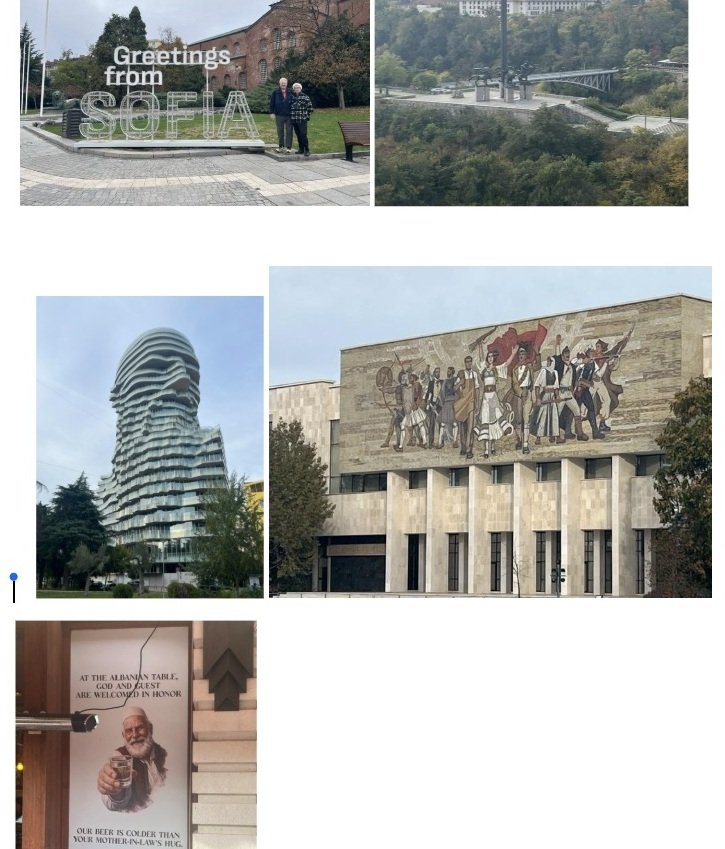
My wife and I recently returned from a trip through the Balkans, specifically Romania, Bulgaria, North Macedonia, and Albania. It was an eye-opening trip which we are pleased to say made us feel good about how these countries have transitioned from their former Communist/Socialist governments and economies to more democratic and market-driven ones.
Earlier in my career, during my time at Schwinn Bicycle, I was afforded the opportunity to take part in the negotiation for a joint venture in Hungary. When that was complete, I was asked to relocate to Budapest to oversee and provide a management presence for the American company partner. In all, my family spent 4.5 years living in Budapest from the late 1980’s to the early 1990’s.
At that time, the Communist Party was in control of the Hungarian government and economy along with the rest of the Comecon countries. During our stay, we experienced life in Hungary under this regime. One of the tenets of Communism is full employment, so everyone had a job. It didn’t matter if the work was actually productive, only that it was a job. Many times, individuals didn’t have much of a say in the manner of their employment.
Communication between individuals was controlled. Getting a telephone installed in your home or business was in most cases a months-long endeavor, if you got one at all. When I was looking for an apartment, the first thing all prospective landlords would show me was the phone and that it worked. The Internet and e-mail didn’t yet exist, so fax machines were a favored mode of international business communication. Fax machines were not available to the general population; they had to be approved by the Hungarian Post Office, they required a license, and they required a phone line.
Retail stores were sparingly stocked with consumer goods sourced from other Central European countries, the Soviet Union, or China. Consumer prices were set by the government without regard for actual costs, though that was starting to change while we were in Hungary. Fuel prices were also set by the government; thus, gasoline and diesel were the same price everywhere and were dependent on imports from the Soviet Union.
If a Hungarian citizen wanted a new car and could afford one, it would be one of those offered from other East European countries: Lada (Soviet Union), Trabant & Wartburg (both from East Germany), Dacia (Romania). Delivery would be literally years in the future.
We had the opportunity to travel and visit Poland and what used to be Czechoslovakia, now the Czech Republic and Slovakia. As Westerners, we were automatically suspect, and our travel into those countries was highly regulated and monitored. When crossing the borders, we had to register our car, any radios or cameras we had, how much hard currency we carried, where we planned to visit, and where and how long we planned to stay. When we left, we had to show those same cameras and radios and provide proof we had exchanged at least $50 of hard currency (in our case American dollars) into the local non-convertible currency. If we couldn’t provide that proof, we would have had to make that exchange before being allowed to leave the country.
But there were other Communist countries we were not allowed to visit at all; I named a few of them in my opening paragraph.
It was during those years that the Soviet Union started to come apart, that the former Soviet satellite countries changed, the Berlin Wall came down, and Germany reunified. We’ve returned to Hungary a few times since the early 90s and have seen firsthand the changes wrought in that country. The transition is remarkable. We wondered if the same might be said of those other hard-line countries we were not allowed to visit back then.
The chance to now find out was compelling, and we have. Everywhere you look, you see people talking on their mobile phones. Retail markets have sprung up, offering products from around the world. Competition for consumers has flourished with product choices unknown under the previous regimes. The general population seems more alive and positive about their circumstances. In many cities of these former Soviet satellite countries, you’d be hard-pressed now to tell the difference from any city in a Western country.
The former East European autos are a memory. They all have been replaced by Fords, Volkswagens, Renaults and others. It is also notable that what we consider luxury cars, Mercedes, Audi and BMW are very plentiful on the streets of these countries, too.
Perhaps one of the most dramatic examples of how things have transitioned occurred while we were in Tirana, Albania. The population is very upset about what they believe is corruption in the government. They took to the streets in mass demonstrations and protests. Large crowds gathered outside the prime minister’s office and residence every day we were there. Those gatherings were tolerated by the government (up to the point of violence when law enforcement intervened), a tolerance that would never been exhibited by the former regime. The outcome remains unclear, but the fact the protests were allowed is remarkable.
One remnant of the former regime is the Communist architecture. The big monolithic concrete block buildings, now referred to as Brutalist Architecture, remain. Though many of these buildings have been repurposed, it is a reminder of what was. That also explains the avant-garde architecture now displayed in new construction in these countries.
As Westerners, we had no fear for our safety or freedoms. We were welcomed by all and found the populations of each country very friendly. It is nice see how a country can change for the better in just one generation. As Americans, we should not undervalue what we have accomplished in the last 250 years nor become blasé about protecting our way of life. Having lived in and witnessed both ends of this spectrum, I don’t.
Contact Steve Bina: steve@humanpoweredsolutions.com